Deeply engaged in high-reliability PCB assembly for wireless modules, leveraging precise processes to optimize CC1310-based solutions, empowering multi-field upgrades in industrial monitoring, smart metering and IoT applications.
Design and Application of a 433M Wireless Module Based on the CC1310 RF Chip
1. Features of the CC1310 Chip
The CC1310 is a key device in Texas Instruments' (TI) latest series of ultra-low-power wireless microcontrollers (MCUs) operating below the SUB-1GHz frequency band. Its exceptionally low active RF and MCU currents, along with minimal power consumption in low-power modes, ensure extended battery life, enabling the use of small button batteries in energy harvesting applications.
The CC1310 integrates a flexible ultra-low-power RF transceiver with a powerful 48MHz Cortex-M3 microcontroller on a platform that supports multiple physical layers and RF standards. A dedicated wireless controller (Cortex-M0) handles low-level RF protocol commands stored in ROM or RAM, maintaining both low power consumption and flexibility. The CC1310 does not compromise RF performance for low power; it boasts excellent sensitivity and robustness (selectivity and blocking) characteristics. As a highly integrated, true single-chip solution, it incorporates a complete RF system and an on-chip DC-DC converter. Proper operation of the CC1310's power and clock management, as well as its wireless system, requires specific configurations and software handling. This can be achieved using TI RTOS, making it advisable to employ this software framework throughout the entire application development process for the device.
2. Package Description of the CC1310 Chip
The CC1310 chip is available in three packages: a 4mm x 4mm RSM VQFN48 package (with 10 GPIOs), a 5mm x 5mm RHB VQFN48 package (with 15 GPIOs), and a 7mm x 7mm RGZ VQFN48 package (with 30 GPIOs). OTOMO primarily utilizes the 4mm x 4mm integrated circuit board, with a minimum size of 14mm x 14mm. The overall framework consists of four main circuits: the power supply circuit, reset and crystal oscillator circuit, RF circuit, and external pin circuit.
3. Applications of the CC1310 Chip
The CC1310 device can operate across various frequency bands, including 433M, 868M, and 915M, and finds applications in automatic meter reading, home and building automation, wireless alarm and security systems, industrial monitoring and safety control, wireless healthcare, active RFID, and other fields. Silicon Transmission Technology has vertically developed a wireless power temperature measurement solution using the CC1310, supporting both CT power extraction (passive) and active power supply.
The wireless power temperature measurement system is a comprehensive temperature monitoring and early warning system with real-time temperature monitoring capabilities. A typical wireless temperature measurement system includes sensors and a data concentrator. Sensors are responsible for detecting temperature data at nodes, while the data concentrator collects data from various sensors. By continuously monitoring the temperature of electrical equipment nodes, the wireless temperature measurement system enables early fault detection. In the event of a fault, it provides timely alerts, identifies the fault location, and offers detailed monitoring data for fault analysis, ensuring the safe and reliable operation of electrical equipment.
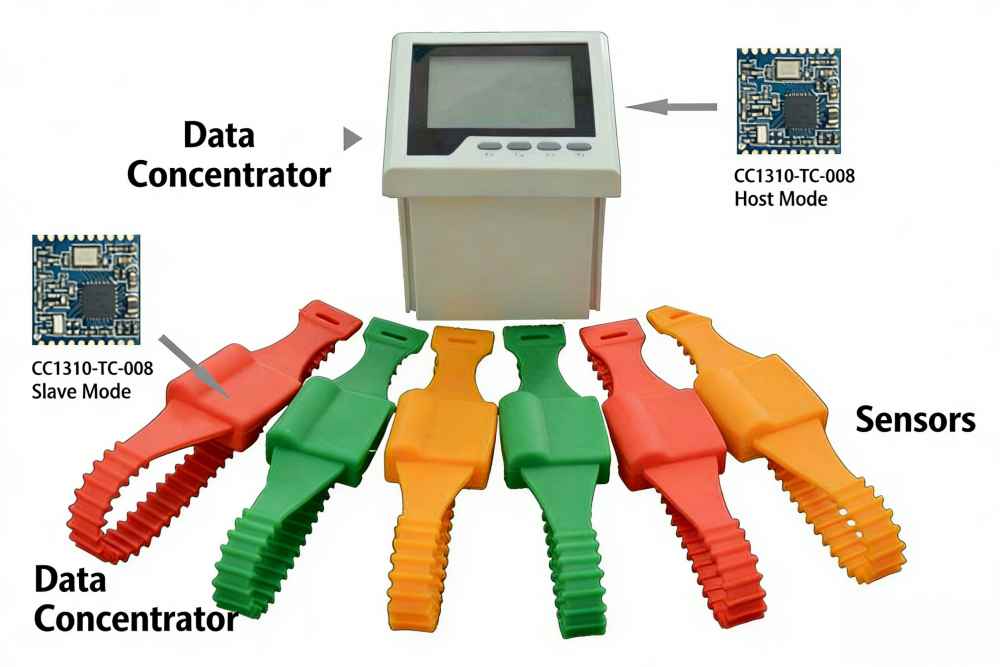
The CC1310-TC008 module's sensor mode is a wireless temperature measurement sensor solution developed by OTOMO specifically for wireless temperature measurement systems. In this solution, the sensor end (master) primarily uses AD analog input to detect and collect temperature data, while the data concentrator end (slave) outputs sensor temperature information via a serial port. This solution has been adopted by many wireless temperature measurement system manufacturers due to its compact size, low power consumption, and long battery life of over five years. Additionally, it supports CT power extraction, offering flexible application options.


