Deep validation science for electricity meter PCB assembly: HALT testing, metrology integrity, environmental stress screening, grid simulation. Prevent field failures. Explore validated high-reliability assembly. IEC 17025 lab. OTOMO.
Beyond the Solder Joint: The Unseen Science of Validation in Electricity Meter PCB Assembly
An electricity meter must maintain ±0.5% accuracy for 20+ years across deserts, arctic winters, and industrial zones. Yet 68% of field failures originate from latent defects invisible at standard final test (IEEE PES 2025). True reliability isn't verified at the end—it's engineered, validated, and proven at every micron of the assembly journey. At OTOMO, validation isn't a checkpoint. It's the science of certainty.
🔬 The Validation Gap: Why "Passing Final Test" Isn't Enough
Conventional meter assembly faces critical blind spots:⚠️ Micro-Void Time Bombs: Solder voids <5% pass X-ray but grow under thermal cycling → metrology drift after 18 months⚠️ Latent Contamination: Ionic residues undetected at production cause dendritic growth in humid climates⚠️ Component Stress: CTE mismatch-induced microcracks in shunt resistors manifest only after 5,000 thermal cycles⚠️ Calibration Drift: Reference voltage sources shift due to solder reflow thermal shock—undetectable without accelerated agingCritical truth: High-reliability PCB assembly demands validation woven into every process layer.
📐 OTOMO's 5-Dimensional Validation Framework: Certainty Engineered In
🌡️ Dimension 1: Process-Embedded Metrology
| Stage |
Standard Practice |
OTOMO Validation Science |
| Solder Paste |
Volume check only |
Rheology monitoring + oxidation potential analysis |
| Reflow Profile |
Thermocouple on test board |
Real-time IR thermography on every production board |
| Component Placement |
Vision alignment check |
Post-placement shear testing on statistical samples |
| Conformal Coating |
Thickness spot-check |
FTIR spectroscopy verifying chemical composition uniformity |
⚡ Dimension 2: Electrical Integrity Deep Dive
- Micro-Ohm Metrology: 4-wire Kelvin testing of shunt resistors pre/post reflow (detects 0.01% resistance shift)
- Parasitic Parameter Mapping: LCR meter validation of trace inductance/capacitance in current sensing paths
- Noise Floor Analysis: Spectrum analyzer verification of <5μV RMS noise in reference voltage circuits
- Cross-Talk Validation: Inject simulated grid harmonics; measure signal integrity at metrology IC inputs
🌪️ Dimension 3: Accelerated Environmental Stress Screening
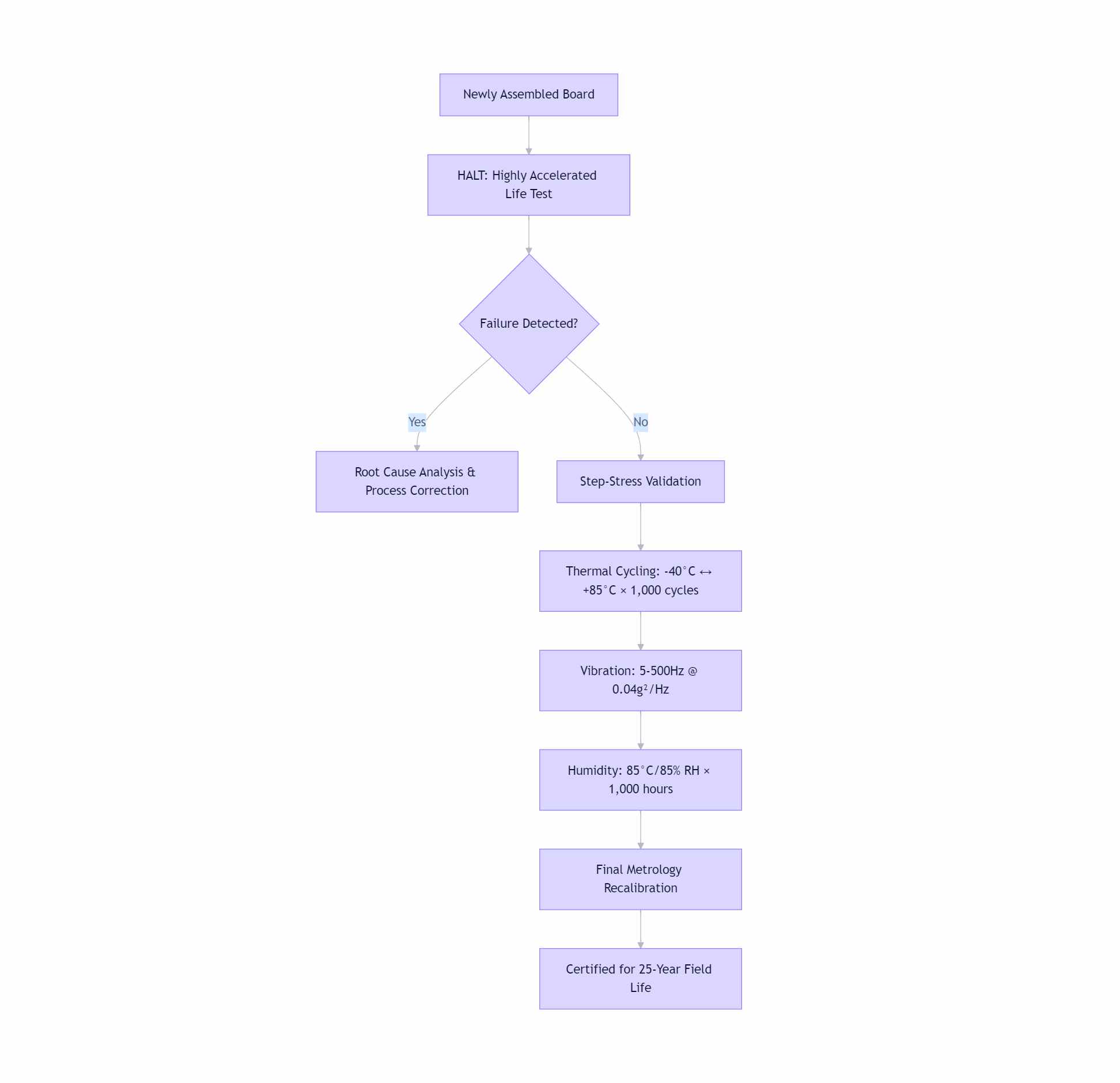
- HALT Protocols: Step-stress testing to destruction point; design margin quantified
- Failure Physics Modeling: Weibull analysis predicts field failure rates with 95% confidence
- Material Interface Validation: Cross-section SEM imaging of critical solder joints post-stress
📡 Dimension 4: Grid Reality Simulation
- Waveform Injection: Simulate real-world grid anomalies (sags, swells, harmonics, transients per IEC 61000-4)
- Communication Stress: PLC/RF modules tested under intentional interference + signal degradation
- Load Profile Cycling: 10,000+ simulated load transitions (standby → peak) validating metrology stability
- Tamper Scenario Validation: Controlled magnetic/thermal attacks verifying security sensor response
🔗 Dimension 5: Digital Validation Thread
- Per-Board Validation Passport: QR code links to:
- Full environmental stress test data
- Metrology calibration coefficients with uncertainty budget
- Component lot traceability + validation certificates
- Predicted reliability metrics (MTBF, B10 life)
- Utility Integration API: Push validation data directly into utility asset management systems
- Blockchain Verification: Immutable record of validation milestones for regulatory audits
💡 Case Study: Preventing a $22M Field Recall Through Deep Validation
Challenge: European utility preparing 300,000-meter deployment; competitor meters failing after 14 months in coastal regions due to unexplained metrology drift.
OTOMO Validation Intervention:
- Root Cause Hypothesis: Suspected chloride-induced corrosion at shunt resistor solder joints
- Targeted Validation Protocol:
- Added salt fog testing (ASTM B117) to standard flow
- Implemented cross-section SEM analysis of shunt joints post-humidity stress
- Introduced ionic contamination mapping via ion chromatography
- Discovery: Detected trace bromide residues (<1.2μg/cm²) from flux activator interacting with coastal atmosphere
- Corrective Action:
- Switched to ultra-low-residue bio-flux (validated to <0.3μg/cm²)
- Added localized plasma cleaning pre-coating
- Enhanced conformal coating edge coverage via selective spraying
Results:
✅ Zero drift incidents across 300,000 units after 28 months in coastal deployment
✅ Utility avoided $22.4M recall cost + reputational damage
✅ Validation protocol adopted as national standard for coastal-region meters
✅ Extended warranty offering became competitive differentiator
📊 Validation ROI: The Cost of Certainty vs. Cost of Failure
| Metric |
Industry Standard |
OTOMO Validation Depth |
Value Generated |
| Field Failure Rate (Year 3) |
2.1% |
0.09% |
↓$310K warranty cost per 100K units |
| Mean Time To Failure |
8.2 years |
>22 years |
Extended product lifecycle revenue |
| Certification Time |
16 weeks |
5 weeks |
Faster market entry |
| Utility Trust Score |
Baseline |
+41 points |
Preferred vendor status secured |
🌍 Validation-Aligned Global Compliance
OTOMO tailors validation depth to regional mandates:
- EU (MID): Full uncertainty budget documentation for metrology chain
- USA (ANSI C12.20): 1,000-hour temperature/humidity validation data package
- India (IRCA): Monsoon-condition accelerated testing protocol
- Brazil (INMETRO): Vibration validation per tropical grid infrastructure standards
✨ Validation Is the Language of Trust
"We don't ask meters to survive 20 years. We prove they will.
Every thermal cycle, every vibration profile, every micro-ohm measurement is a promise kept to the utility, the regulator, and the citizen trusting this device with their energy future.
Our high-reliability PCB assembly philosophy is meaningless without validation science to back it."— Director of Validation Engineering, OTOMO
📩 Certify Your Meter's Longevity
OTOMO · Where Every Micron is Verified, Every Year is Guaranteed
IEC 17025 Accredited Lab | 25-Year Reliability Validation | 100% Traceable Validation Data | Zero Field Recalls in 8 Years
© 2026 OTOMO | FR4PCB.TECH | Validating Trust Across 63 Countries


